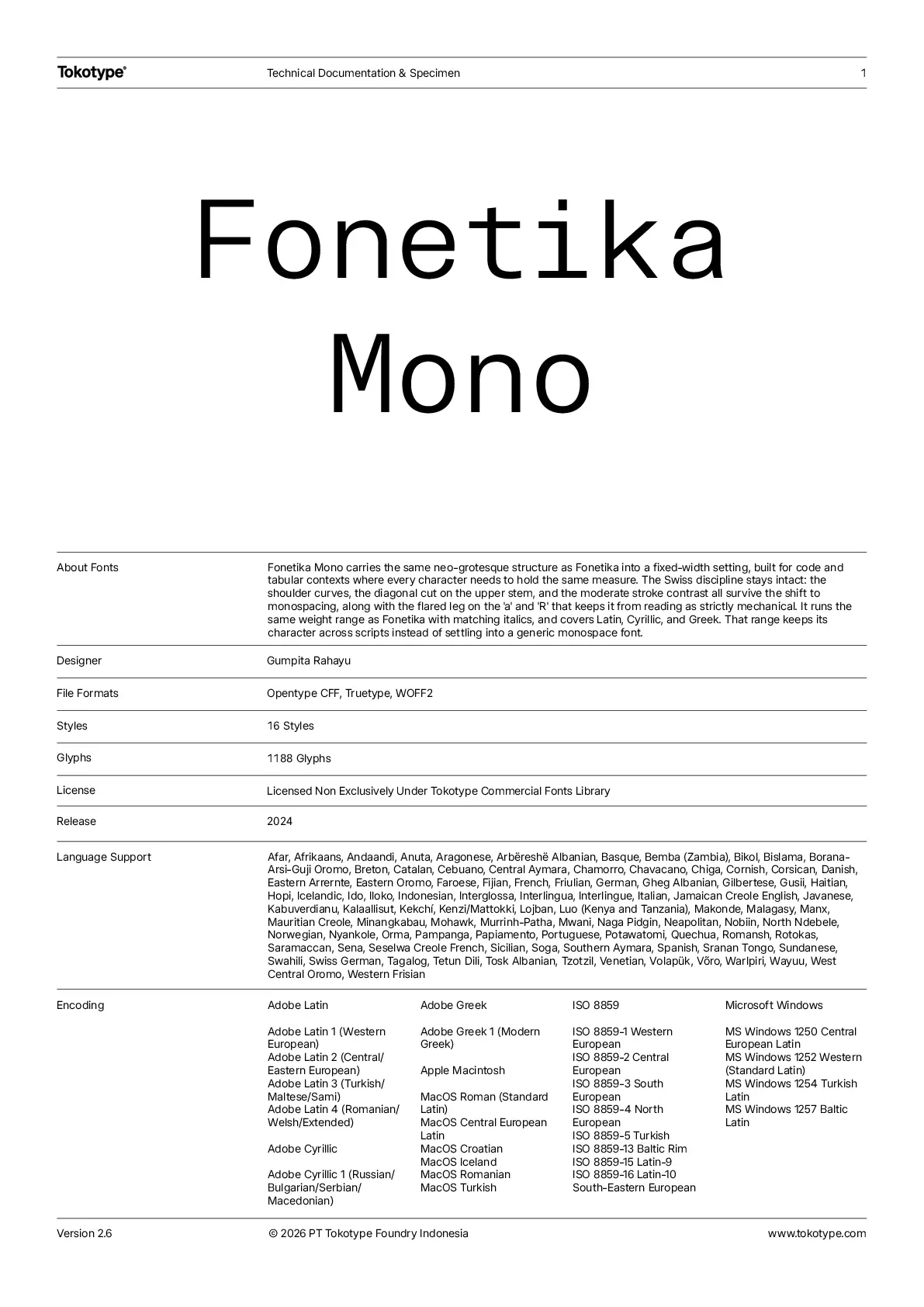
Fonetika Mono Font Family & Specimen - Tokotype

Fonetika Mono

Fonetika Mono

Fonetika Mono Styles

Uprights

ExtraLight

Light

Regular

Medium

SemiBold

Bold

ExtraBold

Black

Fonetika Mono Styles

Italics

ExtraLight Italic

Light Italic

Italic

Medium Italic

SemiBold Italic

Bold Italic

ExtraBold Italic

Black Italic

Variable

180px

0px

1em

North–South Corridor

96px

0px

1em

South Transit Route:40D

96px

0px

1em

Urban Planning Strategy

16px

0px

1.4em

Urban planning as a discipline has been shaped by the urbanization process itself, where cities in various regions have responded to their changing demographics and infrastructure with innovative solutions that are both functional and aesthetically pleasing. Jakarta's public transportation system is a prime example of this phenomenon; its history dates back to the early 20th century when the city was still a major port during the colonial era. The first public bus network was built by the Dutch in 1907, but it wasn't until after Indonesia gained independence that the country began investing more heavily in urban transportation infrastructure. By the mid-1960s, Jakarta had introduced its TransJakarta bus rapid transit system, which connected major hubs across the city. The modernization of public transportation in Jakarta has also been influenced by technological advancements: computer systems have enabled real-time passenger information and optimized traffic flow; the introduction of fuel-efficient buses has significantly reduced emissions. Moreover, urban planners have adopted a people-centric approach to design, integrating pedestrianized zones, green spaces, and integrated mobility services – such as bike-sharing programs – to create more livable cities. Urban regeneration efforts in Jakarta are also reflected in architectural innovations: for example, the revitalization of Old Batavia's historic district has preserved colonial-era buildings while incorporating modern amenities and street furniture. Similarly, architects are reimagining traditional marketplaces and hawker centers with elevated walkways and community-oriented design elements that blur the line between built environment and public space. Urban density, population growth, and infrastructure congestion have been a major driving force behind Jakarta's urban planning challenges. These factors demand solutions that balance functionality and aesthetics. Local transportation networks often struggle to cope, prompting innovations such as shared vehicle services, which can reach high efficiency while accommodating local users with limited budgeting resources. By prioritizing both sustainability and human experience in public spaces, architects are also pushing the boundaries of how cities interact with their inhabitants. In an era of ever-changing environmental conditions, the integration of urban planning and technology offers opportunities to reimagine transportation infrastructure that supports a more dynamic city – one where local needs are addressed through responsive interventions on a scale as small as real-time data mapping. In this way, Jakarta serves as an exemplar for cities around the world grappling with similar challenges. As each responds uniquely to its own distinct urban experience and climate, a global dialogue forms about which design principles prioritize public well-being above all else – an exchange essential in forging effective responses to 21st-century planning conundrums. However even as planners address growing pressures, there is also recognition that sustainability should transcend the realm of environmental issues alone. Rather, its core concerns intersect with urban regeneration goals and long-term community development strategies. Jakarta's future will depend closely on balancing its sprawling metropolis' many dimensions: the intricate interplay between transport systems, infrastructure management, land use planning, population density, and social services – these are interconnected domains with potential impacts across environmental sustainability.

180px

0px

1em

Транспортная Cистема
Solid Outline
Glyph Name
Character Name
Unicode Decimal
Unicode Hex

About Font

Fonetika Mono extends the core family with a monospaced variant, maintaining the clarity and tone of the original while introducing uniform character widths for technical accuracy. Ideal for code, tabular data, or aligned layouts, it brings Fonetika’s thoughtful design into functional, precision-driven contexts—offering consistency, style, and versatility wherever structured typography is essential.

Font Information

Collections

16 Styles – Variable

Version

2.4

File Format

OTF, TTF, WOFF2

Designers

Gumpita Rahayu

PDF Specimen

PDF Specimen

Language Supports

Afar
Afrikaans
Andaandi
Dongolawi
Anuta
Aragonese
Arbëreshë Albanian
Asturian
Atayal
Basque
Bemba (Zambia)
Bikol
Bislama
Borana-Arsi-Guji Oromo
Bosnian
Breton
Catalan
Cebuano
Central Aymara
Chamorro
Chavacano
Chiga
Cook Islands Māori
Cornish
Corsican
Creek
Czech
Danish
Eastern Arrernte
Eastern Oromo
Faroese
Fijian
French
Friulian
Ganda
German
Gheg Albanian
Gilbertese
Gusii
Haitian
Hopi
Hungarian
Hän
Icelandic
Igbo
Iloko
Indonesian
Italian
Jamaican Creole English
Javanese
Jola-Fonyi
Kabuverdianu
Kaingang
Kala Lagaw Ya
Kalaallisut
Kekchí
Kenzi
Mattokki
Kirmanjki
Latgalian
Lower Sorbian
Luo (Kenya and Tanzania)
Makonde
Malagasy
Maltese
Manx
Maori
Mauritian Creole
Minangkabau
Mohawk
Montenegrin
Murrinh-Patha
Mwani
Naga Pidgin
Neapolitan
Nobiin
North Azerbaijani
North Ndebele
Northern Sami
Norwegian
Nyankole
Orma
Pampanga
Papiamento
Polish
Portuguese
Potawatomi
Quechua
Romanian
Romansh
Rotokas
Samoan
Saramaccan
Sena
Serbian
Seselwa Creole French
Sicilian
Slovak
Slovenian
Soga
Southern Aymara
Southern Sotho
Spanish
Sranan Tongo
Sundanese
Swahili
Swiss German
Tagalog
Talysh
Tetun Dili
Tokelau
Tonga (Tonga Islands)
Tosk Albanian
Tsakhur
Tuvalu
Tzotzil
Upper Sorbian
Venetian
Vietnamese
Võro
Walser
Warlpiri
Wayuu
West Central Oromo
Western Frisian
Yoruba
Zapotec
Abaza
Erzya
Moksha
Montenegrin
Nogai
Russian
Rusyn
Serbian
Ukrainian
Modern Greek

Related Family

Fonetika

Learn More

16 Styles – Variable

Download Trial Fonts for Free

Take our fonts for a spin! Enter your name, email address, and the font of your choice. Then, you can download it directly and start testing it for your project.